




Key takeaways
Modern identity management unifies SSO, MFA, governance, and threat protection into a single platform, eliminating the complexity of piecemeal tools.
Passwordless, phishing-resistant authentication improves both security and user experience by removing password fatigue.
Self-service access requests and automated provisioning reduce help desk burden and accelerate employee productivity.
A unified identity platform enables Zero Trust security by continuously verifying users and devices before granting access.
Organizations using dedicated identity platforms typically achieve a lower total cost of ownership than basic “free” identity tools.
Meet Sarah, a marketing manager at a medium-sized furniture company. Sarah remembers when she started as a marketing intern 10 years ago. She started her workdays by entering her passwords multiple times, wrestling with cumbersome VPN connections, and submitting tedious access requests that could take days to fulfill.
Today, her experience is radically different. She opens her laptop, signs in once, and instantly has secure access to all the applications and data she needs.
Let’s walk through a day in Sarah's work life to see how a mature, comprehensive identity platform streamlines the employee experience. Then, we'll explore the broader strategic advantages these solutions deliver to the entire organization, from increased productivity to enhanced security and agility.
The challenge of piecemeal identity management
Most organizations struggle with identity management. Identity is often an overlooked aspect of cybersecurity, involving many tools acquired over time for specific initiatives. One tool for single sign-on (SSO) and multi-factor authentication (MFA), another for lifecycle management, maybe a separate one for privileged access management, and yet another for identity governance. Add in legacy identity tools, and you get a fragmented, complex system that’s difficult to manage, expensive to maintain, and vulnerable to security risks.
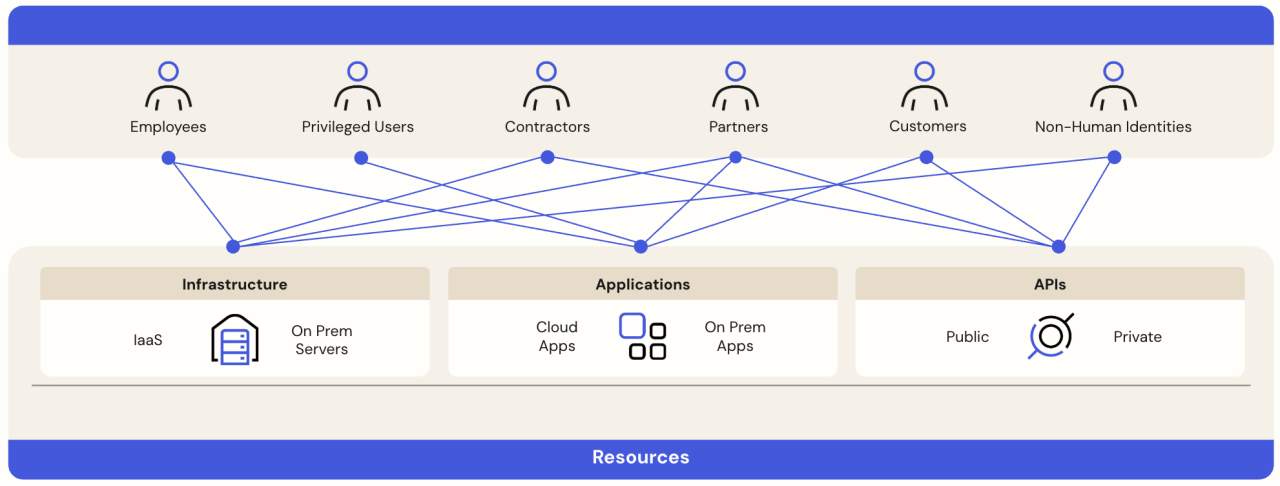 The explosion of identities and resource types creates complexity and identity silos.
How modern identity management works
A comprehensive identity platform delivers seamless security through these core capabilities:
- Single sign-on: Users authenticate once and gain access to all authorized applications without additional logins
- Passwordless MFA: Biometric or device-based authentication eliminates password fatigue while strengthening security
- Adaptive authentication: The system intelligently assesses risk factors like location and device to determine verification requirements
- Self-service access requests: Employees request application permissions through a portal that automatically routes approvals and maintains audit trails
- Access certification: Periodic reviews enable users and managers to confirm or revoke permissions, ensuring compliance with policies
Sarah’s day: A seamless user experience
Sarah's workday begins with a single, secure device login with passwordless MFA through Okta Device Access. She immediately accesses her applications without additional logins thanks to Okta Single Sign-On. Gone are the days of password fatigue and sticky notes filled with login credentials; the passwordless future is here.
When Sarah needs to access sensitive customer data for a campaign review, Okta Adaptive MFA intelligently assesses the risk of this access. Because she's connecting from a new network this morning (Mom’s home Wi-Fi), Okta performs a quick verification through Okta FastPass. This phishing-resistant MFA is seamless and painless. In fact, Sarah doesn’t even realize that Okta recognizes and verifies her corporate laptop to ensure compliance with company security policies.
Later, Sarah needs access to a new marketing analytics platform. Instead of emailing or calling the help desk, she uses the Okta Identity Governance self-service access request portal. She requests the necessary permissions, and the system automatically routes her request to the appropriate approver. This streamlines the process and provides a clear audit trail.
Finally, Sarah participates in a quarterly self-review of access certification. Okta Identity Governance simplifies this process, presenting a clear list of her current application access and enabling her to quickly confirm or revoke permissions, ensuring compliance with regulatory requirements and corporate policies.
Instead of endless frustration and having to ask IT for help, she enjoys a frictionless, productive, and secure experience. She preps for her team call in the afternoon instead of chasing down an approval.
“Okta helps us deliver on a Zero Trust strategy by providing strong device assurance and phishing-resistant policies. This provides a critical stepping stone to achieving a 100% passwordless experience for our end users in the future.”
- Eric Richard, SVP of Engineering and Chief Information Security Officer, HubSpot
Basic identity tools vs. dedicated identity platforms
Organizations often use identity management capabilities offered by collaboration cloud providers as a "free" or low-cost option. Unfortunately, this seemingly inexpensive approach creates significant hidden costs. Implementing and managing basic identity capabilities in a complex, dynamic environment can be far more difficult and costly than originally anticipated.
| Factor | Basic identity tools | Dedicated identity platform |
|---|---|---|
| IT complexity | Closed systems that don't integrate easily with best-of-breed applications; more time spent on troubleshooting | Open integrations with thousands of applications; streamlined management |
| Functionality | Lacks advanced features for security, compliance, and evolving standards | Comprehensive capabilities, including adaptive MFA, governance, and threat protection |
| Scalability | May not scale effectively as the organization grows; costly migrations required | Built to scale with organizational growth and evolving needs |
| Total cost of ownership (TCO) | Hidden costs from implementation, operation, integration gaps, and security risks | Lower TCO when factoring in reduced help desk burden and security incidents |
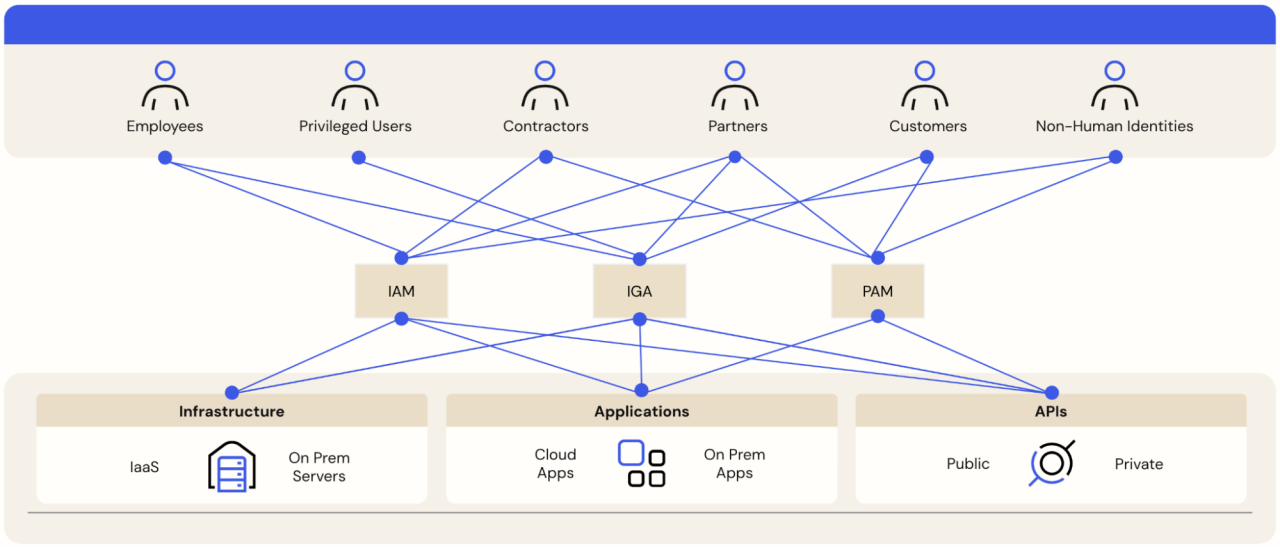 Identity system silos, proliferation of identity types, and tech complexity get in the way.
The organizational view: Strategic benefits
Shifting perspective, let’s look at the significant strategic advantages that mature identity solutions like Okta Workforce Identity can offer Sarah’s organization.
Sarah’s seamless user experience translates to substantial cost savings and productivity gains for her company. Employees are more productive when access is quick and easy. They’re seeing a substantial reduction in help desk tickets related to password resets, access issues, provisioning problems, and other identity-related challenges.
Key benefits of a unified identity platform
- Increased productivity: Employees access applications instantly with single sign-on and passwordless authentication
- Enhanced security: Phishing-resistant MFA and adaptive authentication protect against identity-based attacks
- Reduced costs: Fewer help desk tickets for password resets and access issues
- Improved compliance: Automated access certifications and clear audit trails meet regulatory requirements
- Greater business agility: Automated provisioning and identity orchestration accelerate onboarding and adapt to changing needs
Enhanced security and compliance are key benefits. Okta plays a crucial role in enabling a Zero Trust security framework.
Zero Trust is a security model based on the principle of "never trust, always verify," requiring proper identity verification for every user, regardless of their location or network.
This means adopting proper phishing-resistant identity verification for every user attempting to access resources. Okta's capabilities, like adaptive MFA, Okta Identity Governance, and Identity Threat Protection with Okta AI, lay the groundwork for this approach. By continuously assessing user and device context, Okta helps ensure that only authorized individuals (and policy-compliant devices) can access specific resources.
Advanced threat detection and identity maturity
Identity threat protection is a real-time security capability that detects and responds to identity-based attacks by sharing signals between cybersecurity solutions across different layers.
Okta Identity Threat Protection provides real-time identity threat response by integrating with security solutions that leverage the Shared Signals Framework (SSF) as defined by the OpenID Foundation. This framework reduces the impact of identity-based attacks by enabling signal sharing across different cybersecurity layers, such as the identity and network layers, providing comprehensive, real-time mitigation of threats as they occur.
By leveraging these integrations, Identity Threat Protection enhances detection and response to identity-based attacks, solidifying a Zero Trust posture. It receives signals to respond before threats reach the identity layer and sends signals to other cybersecurity solutions to craft a coordinated response. This allows organizations to evolve from traditional perimeter-based security to a dynamic, identity-centric approach.
Okta automates critical identity processes:
- Automated onboarding and provisioning for new employees
- Seamless transfers
- Efficient offboarding and deprovisioning
This automation reduces manual workflows, minimizing errors and mitigating risk so valuable IT resources can focus on higher-impact projects and initiatives.
Okta Identity Governance includes Okta Lifecycle Management and Okta Workflows, our no-code identity automation and orchestration platform. For example, you can automatically revoke badge access when an employee is offboarded or provide access to a new facility as soon as a user’s title and location change in the HR system.
Identity maturity drives business velocity
Okta provides an identity security fabric to align identity management with broader business objectives. Okta allows organizations to become proactive about identity. Okta Identity Security Posture Management identifies vulnerabilities and security gaps before they can be exploited. Okta's identity orchestration capabilities, such as Workflows and the Okta Integration Network, simplify integration with other systems, creating a cohesive and agile IT shop.
The benefits: reduced risk, increased operational efficiency, and the ability to adapt quickly to evolving business needs and security threats.
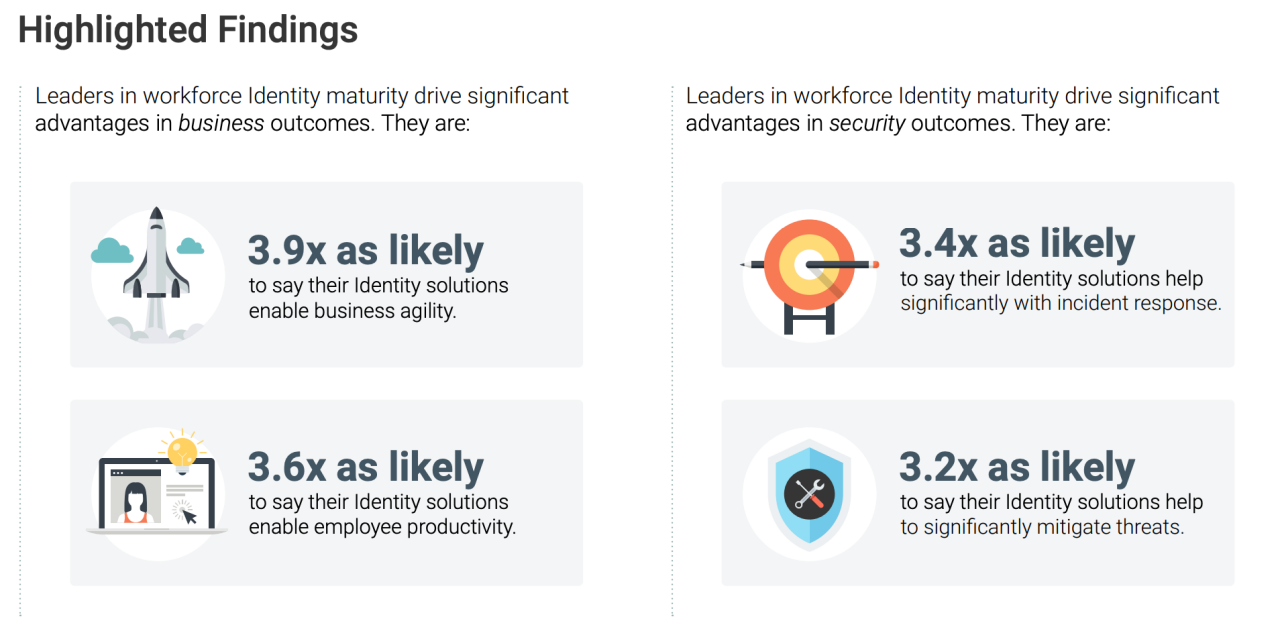
Transform your identity strategy, empower your workforce
As we saw in Sarah’s case, a mature and comprehensive identity platform enhances the individual employee experience and empowers the entire organization. By providing a secure, seamless, and efficient way to manage identity, Okta enables organizations to achieve significant strategic advantages, including increased productivity, reduced costs, enhanced security, improved compliance, and greater business agility.
Is your organization ready to boost workforce productivity while driving measurable ROI? With Okta Workforce Identity, you can simplify access across your entire ecosystem, remove friction for employees, and strengthen security all at once.
Download the Forrester Consulting 211% ROI Study to see how automating identity governance streamlines access workflows, reduces administrative burden, and delivers significant business value.
Frequently asked questions
Identity governance is the set of policies, processes, and technologies that ensure the right individuals have appropriate access to resources. It includes access certifications, self-service access requests, and audit trails to maintain compliance and reduce security risks.
Passwordless authentication is a method of verifying user identity without requiring a traditional password. It uses alternatives like biometrics, security keys, or device-based verification to provide stronger security while eliminating password fatigue.
Piecemeal identity management creates security gaps, increases IT complexity, and raises the total cost of ownership. Fragmented tools don't integrate well, making it difficult to maintain consistent policies and respond quickly to threats across the organization.
This posting does not necessarily represent Okta's position, strategies, or opinion.


